

As the calendar turns toward the holidays, many people feel a familiar heaviness settle in. Decorations go up, invitations arrive, and the world seems to insist on cheer. For anyone who is grieving, this season, and the anniversaries scattered throughout the year, can bring the loss back into sharp focus. If that describes your experience or that of someone you care about, this post is for you.
Grief Takes Many Forms
Grief is the natural response to loss. Most of us link it to the death of a loved one, but people grieve for many reasons, and every kind of grief is real.
Bereavement grief. The grief that follows the death of a partner, parent, child, sibling, friend, or pet. How a person died matters too. Sudden, unexpected, or violent deaths, including suicide, homicide, and accidents, tend to bring a heavier and more complicated grief.
Anticipatory grief. Grief that starts before a loss, often while caring for someone with a serious or terminal illness. It can bring sadness, guilt, anxiety, anger, irritability, and exhaustion, and it can last for months or even years before the death.
Illness-related or "living" losses. Grieving the person someone used to be, as with dementia, or grieving your own health, abilities, or independence after a diagnosis.
Ambiguous loss. Loss without clarity or closure, such as estrangement, a missing person, or a loved one who is physically present but psychologically changed.
Disenfranchised grief. Grief that others may not recognize or validate, for example after a pregnancy loss, the death of an ex-partner, a death by overdose or suicide, or the loss of a pet.
Life-transition losses. Divorce, infertility, job loss, retirement, moving, or a child leaving home.
Grief without a death. Grief is not reserved for bereavement. A breakup or divorce, losing a job, a serious diagnosis, or a life-changing event can all set off real grief.
Job loss is also one studied example: in a significant minority of people, an involuntary job loss leads to complicated grief symptoms, which can in turn bring anxiety, depression, and difficulty finding new work (Van Eersel et al., 2022). How hard a loss hits often depends less on what kind of loss it was and more on how recent it is and how central it was to a person's sense of who they are. Grief is a common human response to many kinds of loss, not only to the death of a loved one.
Breakups are another common grieving experience. Not every breakup feels like a major loss, but some do, and they can bring yearning, intrusive thoughts, trouble sleeping, low mood, and even physical symptoms that mirror grief after a death. Anniversaries, songs, and holidays can stir up memories of a former partner, too. Because these losses are often brushed off ("you'll get over it," "at least nobody died"), people may feel they have no right to grieve. Their pain deserves the same care and compassion, and the strategies in this post apply to them as well.
Grief vs. Depression

Grief and depression can look alike. Both can involve sadness, crying, poor sleep, low energy, and pulling away from others. They are not the same thing, though, and telling them apart matters because they are treated differently.
In grief, the painful feelings are tied to the person who died. They often come in waves, sometimes called "pangs," set off by reminders. Between those waves, many grieving people can still laugh, feel warmth from fond memories, and keep their sense of self-worth.
In depression, low mood and loss of interest are more pervasive and may not only be tied to the loss. Depression often brings feelings of worthlessness, harsh self-criticism, and hopelessness about life in general. Grief and depression can also happen together, and a death can trigger a depressive episode.
Prolonged Grief Disorder
In 2022, the American Psychiatric Association added Prolonged Grief Disorder (PGD) to the DSM-5-TR (American Psychiatric Association, 2022). It recognizes that for a minority of people, the natural healing process stalls. PGD may be diagnosed when, at least 12 months after a loss (6 months for children and adolescents), a person still has intense yearning for or preoccupation with the deceased nearly every day, along with at least three symptoms such as:
Feeling as though part of oneself has died (identity disruption)
Marked disbelief about the death
Avoiding reminders that the person is gone
Intense emotional pain, such as anger, bitterness, or sorrow
Difficulty re-engaging with relationships and activities
Emotional numbness
Feeling that life is meaningless
Intense loneliness
These symptoms must cause significant distress or impairment and go beyond what is expected in the person's cultural, religious, or social context.
One important point for this time of year: grief often spikes around anniversaries, birthdays, and holidays, and these spikes alone do not mean someone has Prolonged Grief Disorder (American Psychiatric Association, 2022). A hard December is not a diagnosis.
PGD is treatable. Grief-focused psychotherapies are the first-line treatment and work well. Antidepressants have not been shown to help PGD itself, but they can help when clinical depression is also present.
You Are Not Alone
Loss touches everyone eventually. Some perspective that may help:
Most grieving people gradually find that their acute grief eases and becomes woven into their lives, often without formal treatment (Rheingold et al., 2024). Clinicians sometimes call this "integrated grief."
A minority of bereaved people, estimated at roughly 1 in 10 after a death from natural causes, develop Prolonged Grief Disorder (Rheingold et al., 2024).
The risk is higher after the death of a child or partner (American Psychiatric Association, 2022).
The risk is also much higher after sudden or violent deaths, such as suicide, homicide, or accidents (Rheingold et al., 2024).
Whether your grief feels manageable or overwhelming, others are walking a similar path, and help is available.
Why Anniversaries and Holidays Are So Hard and How to Prepare

Even years after a loss, many people notice their grief rising as a meaningful date approaches. That is normal. Grief does not have an end date; it changes over time. Surges in yearning, longing, or sadness are common around death anniversaries, birthdays, wedding anniversaries, holidays, and milestone events, and they usually ease with time.
These days can be especially painful because:
The absence is more visible. An empty chair at the table, one less stocking, a tradition that belonged to them.
Expectations clash with feelings. The cultural pressure to be joyful can make grief feel isolating, or even shameful.
The body remembers. Many people feel anxious, tired, or low in the days or weeks before an anniversary, sometimes before they consciously connect it to the date.
Triggers are everywhere. A song, a smell, a favorite food, or a familiar store can bring up a sudden wave of emotion.
Firsts are often hardest. The first holiday season or first anniversary can be especially intense, although later years can catch people off guard too.
How to Plan Ahead
The anticipation is often worse than the day itself. A little planning can help.
Name the hard dates ahead of time. Mark them on your calendar so they don't take you by surprise.
Make a plan, and a backup plan. Decide how you want to spend the day, and give yourself permission to change your mind. Drive yourself to gatherings so you can leave early if you need to.
Decide which traditions to keep, change, or set aside. There is no wrong choice. Some families keep every ritual; others start fresh.
Find ways to honor your loved one. Light a candle, cook their favorite recipe, share stories, look through photos, visit a meaningful place, volunteer, or give to a cause they cared about. Rituals can bring comfort and a sense of connection.
Plan for both connection and rest. Schedule time with supportive people, and time to be alone.
Take care of the basics. Sleep, meals, movement, and time outside all matter. Be careful with alcohol, which can deepen low mood and disrupt sleep.
Line up support in advance. Let a trusted friend know the date is coming, or book a session with your therapist or clinician near the anniversary.
Boundaries, Communication, and Self-Compassion

Boundaries
Grief uses a lot of energy, and you are allowed to protect it. Healthy boundaries during the holidays might include:
Saying no to some invitations, or saying yes for a shorter time
Limiting conversations or questions you aren't ready for
Taking breaks from social media, where holiday posts can feel painful
Choosing a quieter celebration this year
A boundary is not a rejection of the people you love. It is a way to stay connected without running yourself into the ground.
Communication
Loved ones often want to help but don't know how. Many stay quiet because they fear "reminding" you, even though you haven't forgotten. Clear, simple communication can help:
"I'd really like it if we said his name at dinner."
"I may need to step out for a while, and that's okay."
"I'm not up for hosting this year, but I'd love to come for an hour."
"Please don't avoid talking about her. It helps me to remember."
Remember too that people in the same family often grieve differently. One person may want to talk while another wants to keep busy. Patience and openness go a long way. Children grieve as well, and they benefit from honest, age-appropriate conversations and a chance to take part in remembrance rituals.
Self-Compassion
Grief often comes with guilt, self-criticism, and "what if" thinking: "If only I had done something different…" Self-compassion means treating yourself with the kindness you would offer a grieving friend. It has three parts:
Mindfulness: noticing painful feelings without being swept away by them
Self-kindness: replacing harsh self-judgment with warmth
Common humanity: remembering that suffering and loss are shared human experiences, so you are not alone
Self-compassion-focused approaches may help people cope with loss. In practice, that can look like letting yourself cry, letting yourself laugh without guilt, resting when you're tired, and letting go of how you think you "should" be feeling by now.
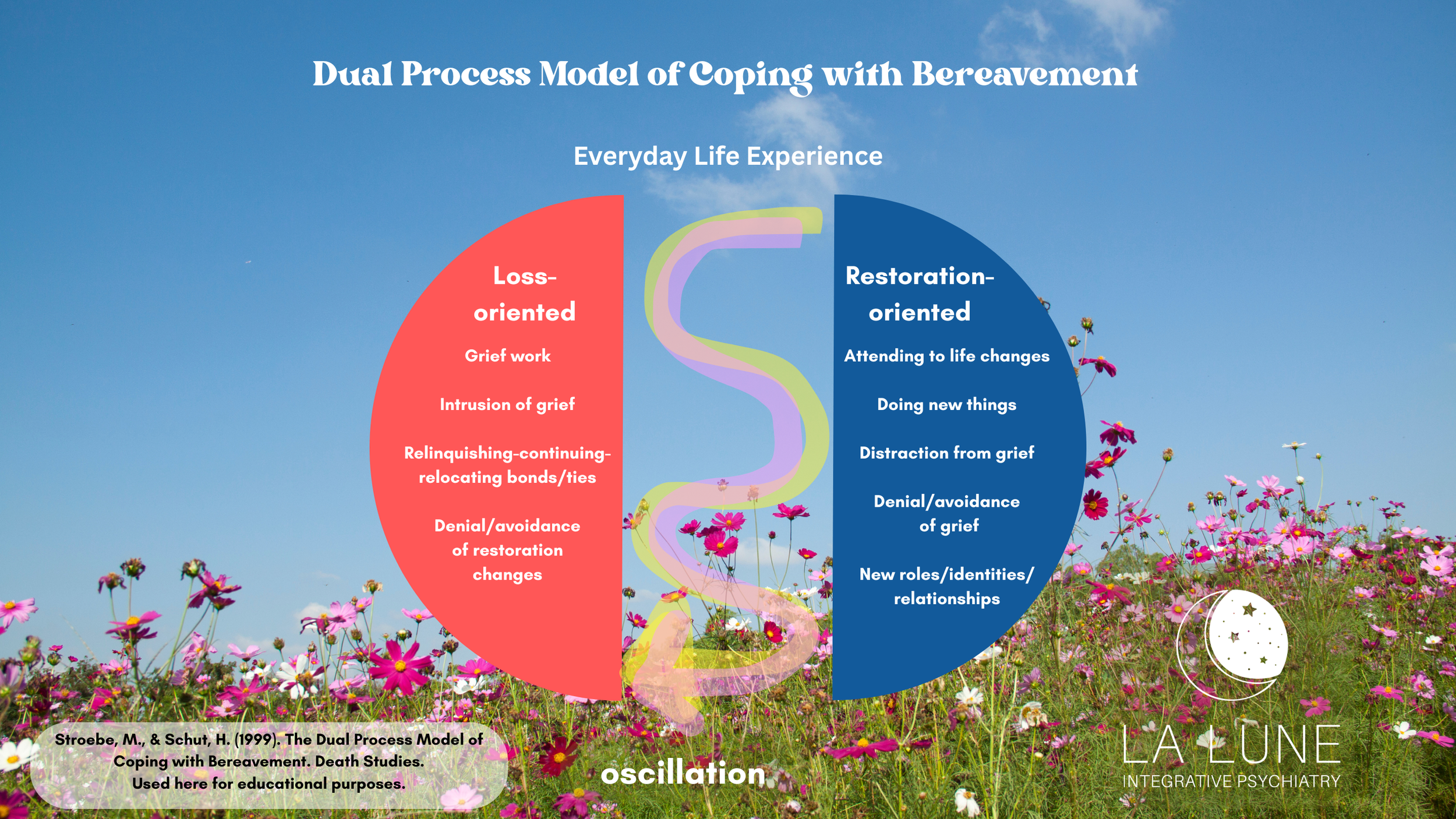
Healthy grieving often swings back and forth between facing the pain of the loss and setting it aside to rest and re-engage with life. Both matter.
When to Reach Out for Help

Consider talking with a mental health professional if:
Intense yearning or preoccupation with your loved one is still present most days a year or more after the loss
You can't function at work, at home, or in your relationships
You feel life has no meaning, or you have lost your sense of who you are
You are relying on alcohol or other substances to cope
You have symptoms of depression, anxiety, or trauma that aren't improving
If you are having thoughts of suicide or of wanting to join your loved one, please get help right away. In the U.S., call or text 988 to reach the Suicide & Crisis Lifeline, or go to the nearest emergency department.
The holidays and anniversaries may always carry some ache. That is true whether you are missing a person who died, a relationship that ended, a job or role that gave your days meaning, your health, or the life you expected to have.
Over time, though, many people find these days can hold both sorrow and something more: love for who or what was lost, gratitude for what it meant, and room for what comes next. Be gentle with yourself this season. You don't have to do it perfectly, and you don't have to do it alone.
If grief is weighing on you this season, our integrative telepsychiatry team serving Arizona, Colorado, Oregon, and Washington is here to help. We take a whole-person approach to care, combining therapy, medication management when needed, and lifestyle support, all from the comfort and privacy of your home. Click here to schedule with a provider today.
This post is for educational purposes and is not a substitute for individualized medical or mental health care.
References
American Psychiatric Association. (2022). Diagnostic and statistical manual of mental disorders (5th ed., text rev.). https://doi.org/10.1176/appi.books.9780890425787
Rheingold, A. A., Williams, J. L., & Bottomley, J. S. (2024). Prevalence and co-occurrence of psychiatric conditions among bereaved adults. JAMA Network Open, 7(6), Article e2415325. https://doi.org/10.1001/jamanetworkopen.2024.15325
Van Eersel JHW, Taris TW and Boelen PA (2022). Job loss-related complicated grief symptoms: A cognitive-behavioral framework. Front. Psychiatry 13:933995. doi: 10.3389/fpsyt.2022.933995